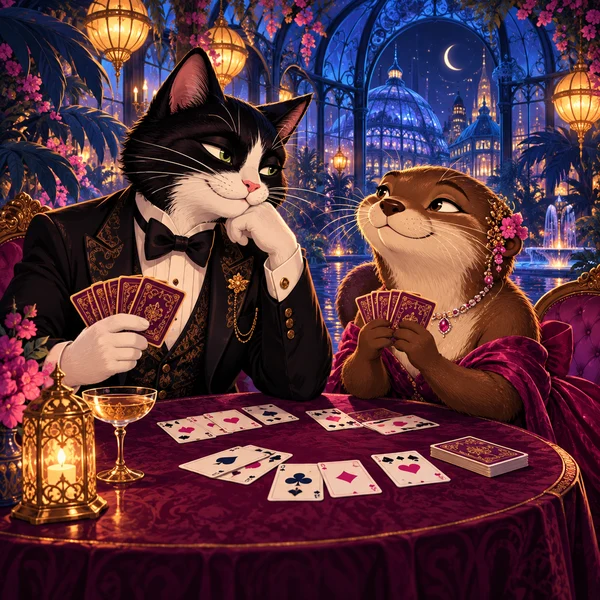
How to play Gin Rummy
Play against one computer or invite a friend. Each player receives ten cards from a standard 52-card deck. Aces are low. Build sets of three or four equal ranks, or runs of three or more consecutive cards of the same suit. Each card belongs to at most one meld.
The opening upcard
The nondealer can take the first face-up card or pass. If they pass, the dealer gets the same choice. If both pass, the nondealer must draw from the stock. After that, every turn begins by drawing from stock or the top of the discard pile, then ends by discarding one card. A card just taken from the discard pile cannot be returned immediately.
Deadwood, knocking, and gin
Unmelded cards are deadwood: aces count one, number cards their value, and J/Q/K ten. We find the lowest-deadwood arrangement, including overlapping meld possibilities. After selecting your discard, Knock is available if the remaining ten cards have at most ten deadwood points. Zero deadwood is gin. This version uses standard ten-card gin, without an eleven-card big-gin variant.
Scoring and layoffs
A knocker normally scores the opponent’s remaining deadwood minus their own. After a knock, the opponent may lay unmelded cards onto the knocker’s melds; the engine finds their best legal meld-and-layoff arrangement. There are no layoffs against gin. Gin scores a 25-point bonus plus the opponent’s deadwood. If the opponent reaches equal or lower deadwood after layoffs, they undercut: 25 points plus the difference. A tied deadwood count therefore scores 25 for the opponent.
Play to 100 or 250 points. Scores accumulate across deals, and the dealer alternates. This match uses hand scores only, without additional match/box bonuses. If the stock reaches two cards, the current player may still take the discard; attempting another stock draw ends the deal without a score.
Three useful tips
- Choose discards that reduce deadwood while preserving pairs and neighboring suited cards.
- Watch what your opponent takes from the discard pile before feeding them a related card.
- A low knock can be better than waiting for gin, but consider the risk of an undercut.